The Advisor Who Had No Time to Advise
Financial advisors were drowning in admin. The work around the work was eating the work itself. I was brought in to help a major financial services firm digitally transform their sales process. But the real challenge wasn't technology. It was getting the right people in the same room, pointed in the same direction, building toward the same vision.
Role
UX Strategist & Lead Designer
Team model
4-in-a-box
Captured in workshops
100+ ideas
Current / Pilot / Future
3 states
The Problem Nobody Had Fully Named
When I first engaged with this project, the frustration was palpable but scattered. Sales executives complained about inefficiency. Managers pointed at adoption metrics. Technology teams had solutions waiting for problems. Business stakeholders had goals that didn't quite match anyone else's.
Everyone was describing different parts of the same elephant.
What the research made clear: financial advisors had been operating on age-old practices with minimal technology. The digital tools that did exist were built around them, not for them. The result was a compounding tax on their time: hours lost to manual pre-work before every client meeting, administrative overhead that could have been automated years ago, post-meeting notes captured inconsistently if at all, and sales follow-up that depended on individual memory rather than intelligent systems.
Every hour spent on these tasks was an hour not spent with a client. And in financial advisory, client time is the product.
The friction fell into two categories. Things that needed to be eliminated: manual and laborious pre-meeting prep, administrative tasks like ordering marketing materials, time-consuming travel and expense logistics, and post-meeting notes that were captured inconsistently or not at all. And things that needed to be improved: the quality and quantity of client interactions, sales follow-up, the building of long-term relationships, and the ongoing training and coaching of the sales team.
Three deeper structural problems surfaced through workshops and desk research. Siloed technology teams were building solutions in isolation, without a unified view of the sales experience. Front-line advisors were invisible stakeholders: managers had seats at the table, but the people actually doing the work didn't. And business and technology priorities were misaligned, not because either side was wrong, but because they had never been asked to reason from the same map.
The Vision That Anchored Everything
Before any wireframe, any roadmap, any feature discussion, we needed a north star vivid enough to navigate by.
“Make the sales process so easy that the end client feels going to any competitor extremely hard. Be frictionless. Anticipatory. Consultative. Intelligent.”
That wasn't marketing language. It was a design brief. Every decision we made ran through that filter.
Translated into concrete goals, the vision meant three things. First, get financial advisors in front of end clients for the maximum possible time. Second, deliver the right content at the right moment in the right context, increasing value through smarter, more agile marketing. Third, surface next best actions through data and analytics, not guesswork or memory.
“Sales efficiency, sales effectiveness, employee engagement, and partner integration was the key.”
Success had to be measurable. The KPIs we agreed on were unambiguous: increase in the number of client engagements, increase in close rates and deal size, adoption of digital tools, alignment to best practices, reduction in the length of sales cycles, growth in market share, and higher ROI. These weren't aspirational metrics. They were the standard the product was held to.
Getting Everyone in the Same Room
The single most important early move was structural. I insisted on getting business, technology, and actual sales executives in the same room before a single design decision was made.
This sounds obvious. It almost never happens.
I designed and facilitated a half-day workshop that pulled these groups out of their silos and put them in direct conversation. For many of the technology and business stakeholders, it was the first time they had heard advisors describe their own experience in their own words, not filtered through a manager's interpretation or a survey. The empathy maps, journey fragments, and raw insights from that room became the research foundation for everything that followed.
Two Kinds of Advisor, One Shared Struggle
The empathy mapping work revealed something subtle but important: not all sales executives are the same, and designing as if they were would be a critical mistake.
External advisors travel, present in person, and run on a completely different rhythm. Their pain lives in prep time, on-the-road access, and the post-meeting administrative collapse. Every client visit requires a morning of preparation and an evening of documentation.
Internal advisors work from an office and manage client relationships remotely. Their pain is different in texture but just as costly: information overload, constant tool-switching, and the friction of coordinating across systems that were never designed to talk to each other.
But here is what unified them: both types collaborate constantly. A lead doesn't just belong to one person; it moves through both. Any solution that optimized for one at the expense of the other would create new friction while solving old friction. Both profiles were kept visible throughout the entire design process, revisited at every major decision point.
Each profile was grounded in research, not assumption. They weren't personas built to satisfy a process requirement. They were working documents, referred to constantly to pressure-test whether design decisions were landing in reality or in theory.
The Journey Map That Filled a Wall
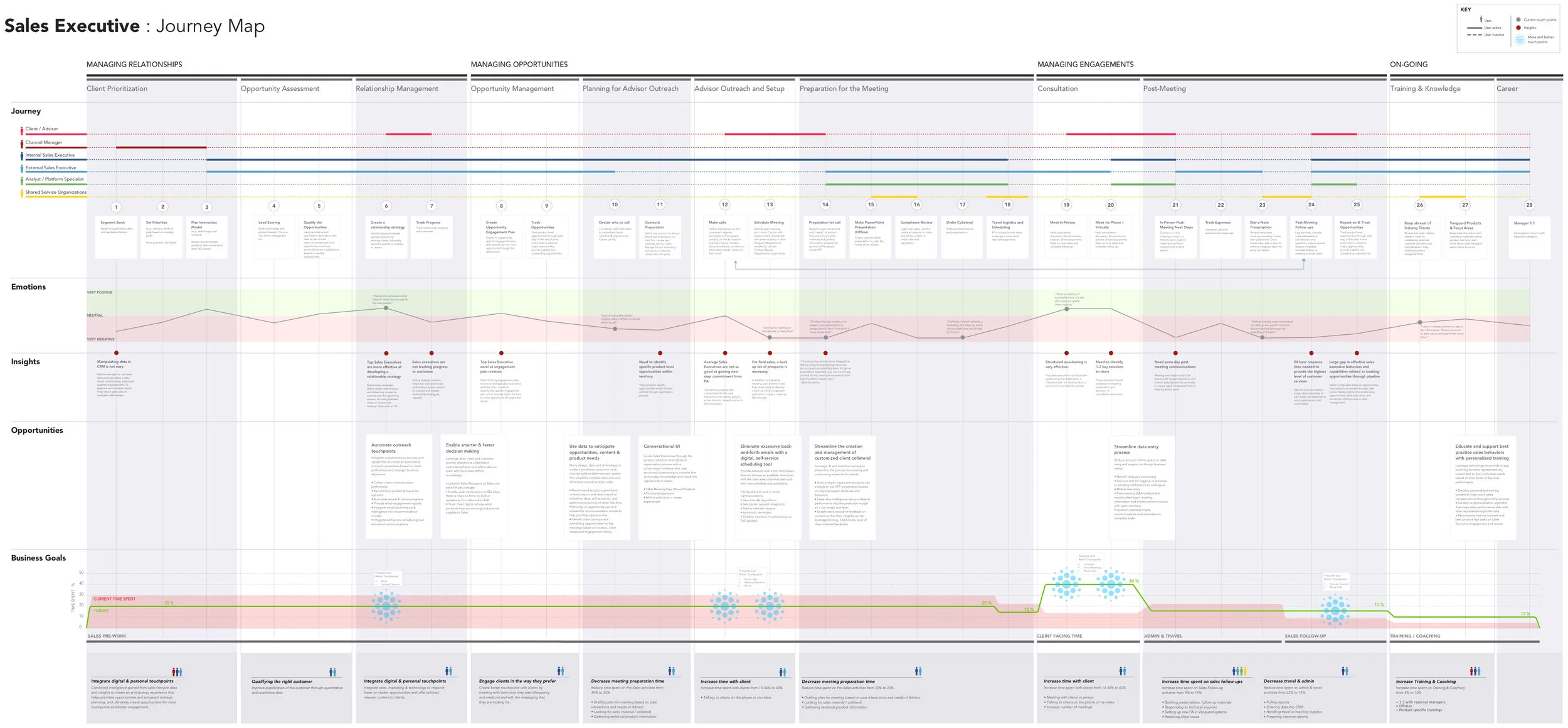
Once we had the empathy data, I built a comprehensive customer journey map covering the full sales executive cycle, from prospecting through close through ongoing relationship management.
At the macro level, the journey organized into four phases: managing relationships, managing opportunities, managing engagements, and ongoing development. But the real value wasn't the phases. It was the emotions layer. Charting the affective arc of the sales journey made visible exactly where advisors were energized, where they were frustrated, and where they felt abandoned by the tools they were given. Towards the bottom of the map, it also tracked the business goals the company wanted to achieve alongside current performance levels, so strategy and reality could be read side by side.
The macro view told the story at 50,000 feet. But the power of the artifact came from zooming in. Every step had nuance, and every nuance had a decision hidden inside it. The detail view made those decisions impossible to ignore.
The artifact was printed at 8 feet by 16 feet and installed on the war room wall.
“The customer journey map has brought all of us together on the same page. No pun intended!”
Senior-most Client Stakeholder
It stayed on that wall for the duration of the project. Every alignment conversation happened in front of it. It was the team's shared language.
Making the Future Feel Real
Having a journey map of the present is useful. Having a vivid picture of the future is what generates momentum.
I built a storyboard depicting a day in the life of a sales executive in the transformed experience: one where intelligent automation handled the admin, recommendations surfaced the right content at the right moment, and the advisor could walk into every meeting prepared without spending the morning getting there.
The storyboard wasn't a prototype. It was a provocation. And it worked.
Across a series of workshops anchored by that narrative, we captured 100+ ideas and capabilities from participants across business, technology, and sales. The storyboard gave people a concrete future to react to, which is far more generative than asking them to imagine one from scratch.
From 100 Ideas to a Prioritized Roadmap
A hundred ideas with no prioritization is just noise. The next phase was turning that noise into a signal.
I ran three additional half-day workshops to evaluate every captured capability against two dimensions: business value and implementation effort. This wasn't a filtering exercise. It was an alignment exercise. Getting product management, business stakeholders, and technology leads to agree on priorities together is itself a form of organizational design.
What made these sessions productive wasn't just the framework. It was the room composition. The people closest to the problem and the people closest to the solution were making decisions together, not passing requirements through layers of translation.
The output was a prioritized feature list that everyone had helped build, which meant everyone had a stake in defending it. That buy-in is not a soft outcome. It is the difference between a roadmap that gets followed and one that quietly sits in a folder.
From there, the team spent a week in the war room translating priorities into a phased product roadmap spanning multiple quarters and years. Business priorities, user needs, and technical dependencies were all visible on the same timeline. The roadmap was printed, pinned to the wall, and treated as a living document, revised when business priorities shifted, updated when user feedback demanded it.
Five Pillars of the Product
The workshop process ultimately shaped five distinct product pillars. A portfolio architecture that gave every capability a home and every team a clear lane.
Personalization. Automated content recommendations tailored to each advisor's activities, clients, and stage in the sales cycle.
Content Discovery. A centralized home for sales materials and playbooks, with version control and expiration management built in.
Content Delivery. Tools for getting the right content to clients: personalized emails, secure microsites, virtual and in-person presentation support.
Book of Business. Deep CRM integration that connects sales activity to specific opportunities and surfaces recommendations where advisors actually work.
Sales Performance Optimizer. The AI-powered daily command center: tasks, reminders, recommendations, and emerging-tech productivity features, all in one view.
Each pillar also served a secondary function: it defined the skill profile of the team needed to build and maintain it. Product portfolio as talent architecture. A clarity that most digital transformation projects never achieve, and one that made future hiring and team design far less guesswork.
Going Deep: Service Maps
The journey map was the 50,000-foot view. But every step of that journey had its own operational complexity: legacy systems, manual handoffs, approval workflows, human interventions that technology hadn't touched yet.
I developed service maps for the highest-priority moments in the journey, tracing the current state, the pilot state, and the future state side by side. One of the most revealing was step 21 in the journey map: post-meeting activities, the administrative collapse that follows every client interaction. The service maps helped teams align on what was actually happening, made legacy systems visible to the technology team, and identified exactly where intelligent automation could replace manual intervention.
The pilot state wasn't the final vision. It was a bridge. A set of improvements achievable with the technology already in the building, reducing the highest-friction points without requiring a full platform rebuild. That pragmatism mattered, because it created early wins that kept belief in the transformation alive.
The future state was the version worth building toward: voice-captured notes flowing directly into the CRM, structured automatically, nothing lost. What had required deliberate effort after every meeting became something that happened alongside the meeting itself.
The future-state service map became the brief for the first prototype.
Prototype: Post-Meeting Notes
Using the future-state service map as a blueprint, I designed and tested a conceptual prototype for post-meeting note capture. The experience allowed advisors to record notes in the moment, spoken or typed, with direct integration into the CRM system.
This engagement used an approach of failing fast to succeed later. The prototype was a thinking tool, not a finished product. A way to make the vision concrete enough that advisors could respond to it, poke holes in it, and tell us what we had gotten wrong.
Three screens tell the core story. The daily command center reduced the cognitive load of starting each day: tasks, client context, and next best actions without opening five different systems. Lead prioritization surfaced which opportunities deserved attention and why, based on deal stage, relationship history, and behavioral signals. And post-meeting capture let advisors record notes in the moment, spoken or typed, without the administrative collapse that followed every client interaction.
We tested with real advisors. The feedback was immediate and practical. They were precise about what they wanted the system to handle and what they wanted to retain control over. That distinction, between automation that helps and automation that intrudes, shaped every subsequent iteration.
Shifting the Organization's Mental Model
Perhaps the most durable outcome of this engagement wasn't a prototype or a roadmap. It was a shift in how the organization thought about technology investment.
“Digital transformation is less about technology and more about people.”
That idea shaped everything. One can acquire almost any technology. What cannot be bought is the organizational capacity to use it well: the ability to adapt, to close the gap between talent supply and demand, to future-proof the people doing the work. Before this project, the team operated in project mode: discrete initiatives with start dates, end dates, and success metrics defined by delivery, not outcomes. We introduced product thinking, a model where technology investments are organized into value streams, co-owned by business, IT, and marketing, and evaluated by ongoing outcomes rather than whether something shipped on time.
Three organizational shifts took hold. Products, not projects: the difference isn't semantic. Projects end. Products evolve. The distinction changes how teams are funded, staffed, and measured. A new ownership model: business and technology stopped sitting across the table from each other and started co-owning the same outcomes. A balanced approach: by working across strategy, service design, UX, and technical architecture simultaneously, the engagement demonstrated that digital transformation works best when it respects the full complexity of the problem.
“A strategy is the foundation for the entire lifecycle of the product and product family. The strategy keeps the team aligned on what matters most.”
What I Learned
Front-line users are the most important stakeholders you are least likely to have in the room. Managers and executives shape the requirements. But the people doing the work know what is actually broken. Fight for their seat at the table.
A storyboard can unlock what a requirements doc never will. Showing people a vivid, human picture of the future frees their imagination in a way that feature lists simply don't. Vision artifacts are strategy tools, not just communication tools.
Transformation is an alignment problem before it is a design problem. The technology was acquirable. The harder work was getting the right people to reason from the same picture, agree on the same priorities, and trust each other enough to build something new together.
Pilot fast, learn real. The fail-fast-to-succeed-later model gave us permission to test risky ideas early, before they were expensive. Every prototype that didn't work was information. Every one that did was a proof of concept for the next conversation.